
The Dangers of Underestimating Lunar Dust
Artemis II has just flown around the Moon. China wants to set foot on it by 2030. And across all these missions, the greatest engineering risk is neither the vacuum nor the radiation. It is the dust.

On April 6th, 2026, for the first time since Apollo 17 in 1972, four people flew around the Moon. NASA’s Artemis II mission completed its lunar flyby with astronauts Reid Wiseman, Victor Glover, Christina Koch, and Canadian astronaut Jeremy Hansen aboard Orion. A historic image, and also an urgent reminder of what still needs to be solved before anyone returns to the surface.
Because if lunar dust was the biggest operational problem during the Apollo missions of the 1970s, in the permanent bases planned for the coming decade it could become a critical engineering risk. And the race to get there allows no delays.
THE RACE IS BACK
Artemis is not alone. While NASA is planning the first crewed landing since Apollo 17 for 2028, China is working in parallel to arrive before 2030 with its own crewed lunar exploration program. Its spacecraft Mengzhou and the Lanyue lander, “embracing the Moon,” from a poem by Mao, have been in testing for years. The Long March 10 rocket successfully completed its ignition tests in February 2026.
“The countries that get there first will write the rules of what we will be able to do on the Moon.”
— Mike Gold, former NASA Associate Administrator, before the U.S. Senate, 2025
THE ENEMY NO ONE EXPECTED
Buzz Aldrin described lunar dust as the biggest operational problem of Apollo, not reduced gravity, not the vacuum. The regolith infiltrated suits, clogged mechanisms, and scratched visors. And that was during missions lasting only a few hours. With permanent bases in mind, this issue becomes a critical engineering risk.
Lunar regolith is the result of four billion years of meteorite impacts and radiation, with no erosion from water or wind. Each particle retains sharp, jagged edges. At a microscopic scale, it looks like broken glass, and behaves exactly like it.
IS MOON DUST TOXIC?
The short answer is: inhaling lunar dust is indeed toxic. The long answer requires understanding why lunar regolith behaves differently from most terrestrial dusts.
Regolith is mostly silicate minerals and a large fraction of impact-generated glass (amorphous). When people hear “silica dust,” they think of silicosis, a disease caused on Earth by long-term inhalation of respirable crystalline silica. Lunar soils are not uniformly rich in those free crystalline silica minerals, so silicosis is not the only, or even the main reason lunar dust is concerning. The bigger issue is that lunar dust can be highly reactive and hard to manage: very fine particles, minimally weathered “fresh” surfaces, and a chemistry shaped by space rather than Earth’s atmosphere and water.
Particles are so fine that they penetrate deep into the lung alveoli, where clearance is slow and incomplete.
Exposure to solar radiation and the solar wind charges the dust electrostatically, making it extremely adhesive and increasing the likelihood that it is transported into habitats.
It contains nanoparticles of metallic iron that can generate oxidative stress and inflammatory response in cells.
WHY SIMULANTS ARE MORE URGENT THAN EVER
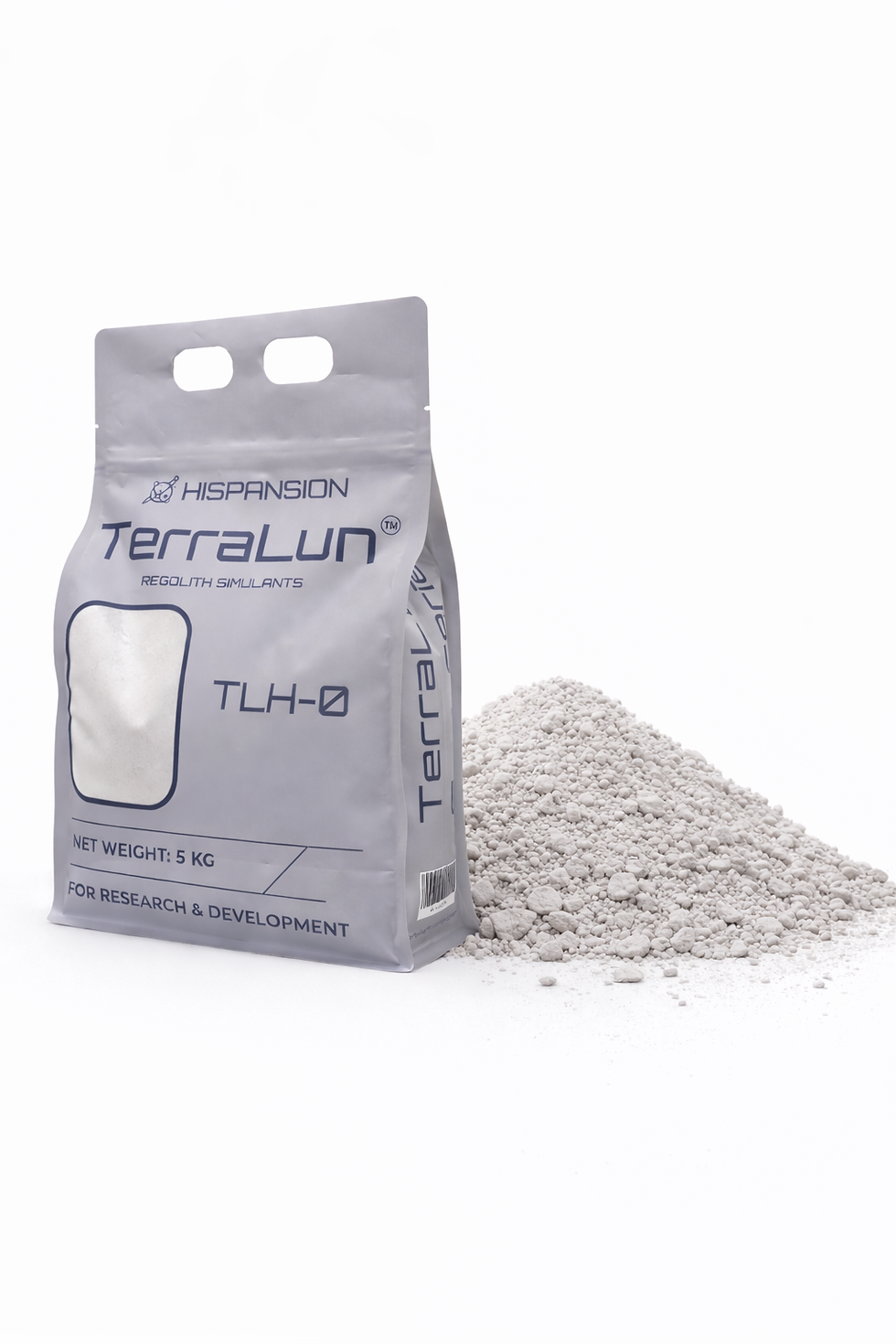
With two crewed programs advancing in parallel and lunar bases on the horizon, the need to understand regolith has multiplied. Real lunar samples are scarce and tightly controlled. We cannot simply go and measure in situ. That is why regolith simulants, materials produced on Earth that replicate its physical and chemical properties. have become the reference tool for testing suits, developing dust mitigation systems, conducting geotechnical experiments, and advancing ISRU.
But not all simulants are equal. The quality of the data depends directly on the fidelity of the material. According to NASA’s Figures of Merit (FoM), Hispansion currently offers the highest-fidelity regolith simulant in the world.
This is not our own claim, independent third-party analyses support it, placing us as the best commercially available lunar regolith simulant.

Comments