
Fire Test on the Lunar Surface by NASA
In late 2026, NASA will deliberately ignite a fire on the Moon. It is not a metaphor. It may be the most important fire safety experiment in the history of human spaceflight.

In late 2026, NASA will deliberately ignite a fire on the Moon. This is not an accident, it is a deliberate, controlled, and long-overdue experiment. The mission is called FM² (Flammability of Materials on the Moon), and it represents the first time in history that a combustion experiment will be conducted on another planetary body.
The timing could not be more relevant: following the crewed success of Artemis 2.
Fire Does Not Behave the Same Everywhere
On Earth, heat makes combustion gases rise. This buoyant flow draws fresh oxygen into the flame, sustaining it. But if the flow becomes too fast, the chemical reactions cannot keep up and the flame extinguishes itself: a phenomenon known as blowoff. In this sense, Earth’s gravity can act as a natural fire suppressor.
"Lunar gravity has been found to increase the limits of flammability for some materials compared to Earth gravity, presenting a Goldilocks zone of reduced convective heat loss, while generating enough buoyant flow to replenish fresh oxygen into the flame zone."
— NASA NTRS · Flammability of Materials on the Moon (FM²) · 2024
Now place that same material on the Moon, where gravity is one-sixth of Earth's. The convective flow still exists, but is much slower. Oxygen continues reaching the flame, enough to sustain it, but the blowoff effect disappears.
The result is a flame sphere more stable, more persistent, potentially capable of burning materials that on Earth would simply have self-extinguished.
What We Have Learned Burning Things in Space
This is not the first time NASA has studied fire under reduced gravity. Decades of experiments have built, brick by brick, our current understanding and its limits.
What none of these experiments could achieve: real, long-duration combustion in authentic lunar gravity. That is precisely what FM² will change.
What is the FM² experiment about?
The mission will burn four solid fuel samples inside a sealed combustion chamber delivered to the Moon aboard a CLPS lander (mission CP-21). The system is fully self-contained: the lander provides power, while the chamber operates autonomously.

This figure is important because it shows that FM² is not an open fire on the Moon. The combustion happens inside a controlled chamber that sits on the lunar surface, allowing researchers to observe flame behavior in real lunar gravity without exposing the surrounding environment to an uncontrolled fire.
Cameras, radiometers, thermocouples, and oxygen sensors will track how the fire develop, spread, stabilize, or extinguish over longer durations than previous reduced-gravity experiments.
Lunar Regolith Flammability
Regolith is expected to be a constant operational challenge for seals, surfaces, filters, and habitat systems, so understanding baseline fire behavior in lunar gravity is the first step before studying how dust contamination might affect those systems in the future.
Aerosolized lunar dust suspended inside a pressurized habitat creates a potential particle cloud that could modify local flame dynamics, altering how oxygen distributes around a burning surface. Additionally, regolith contains roughly 41–45% oxygen bound in metal oxides like silicon, aluminum, iron, magnesium and has been shown to form combustible thermite-type mixtures with magnesium. While this is primarily relevant for in-situ industrial applications, it illustrates the latent chemical reactivity of the lunar soil.
Finally, ultrafine dust infiltrating environmental control systems can degrade the regulation of oxygen concentration, the single most critical parameter for flammability, with consequences difficult to predict from Earth-based models.
Why Simulants Are More Urgent Than Ever
As lunar missions move toward permanent human presence, fire safety can no longer rely on Earth-based assumptions. Direct testing is limited, which makes experiments like FM² essential. They provide the first real data on how materials burn beyond Earth.
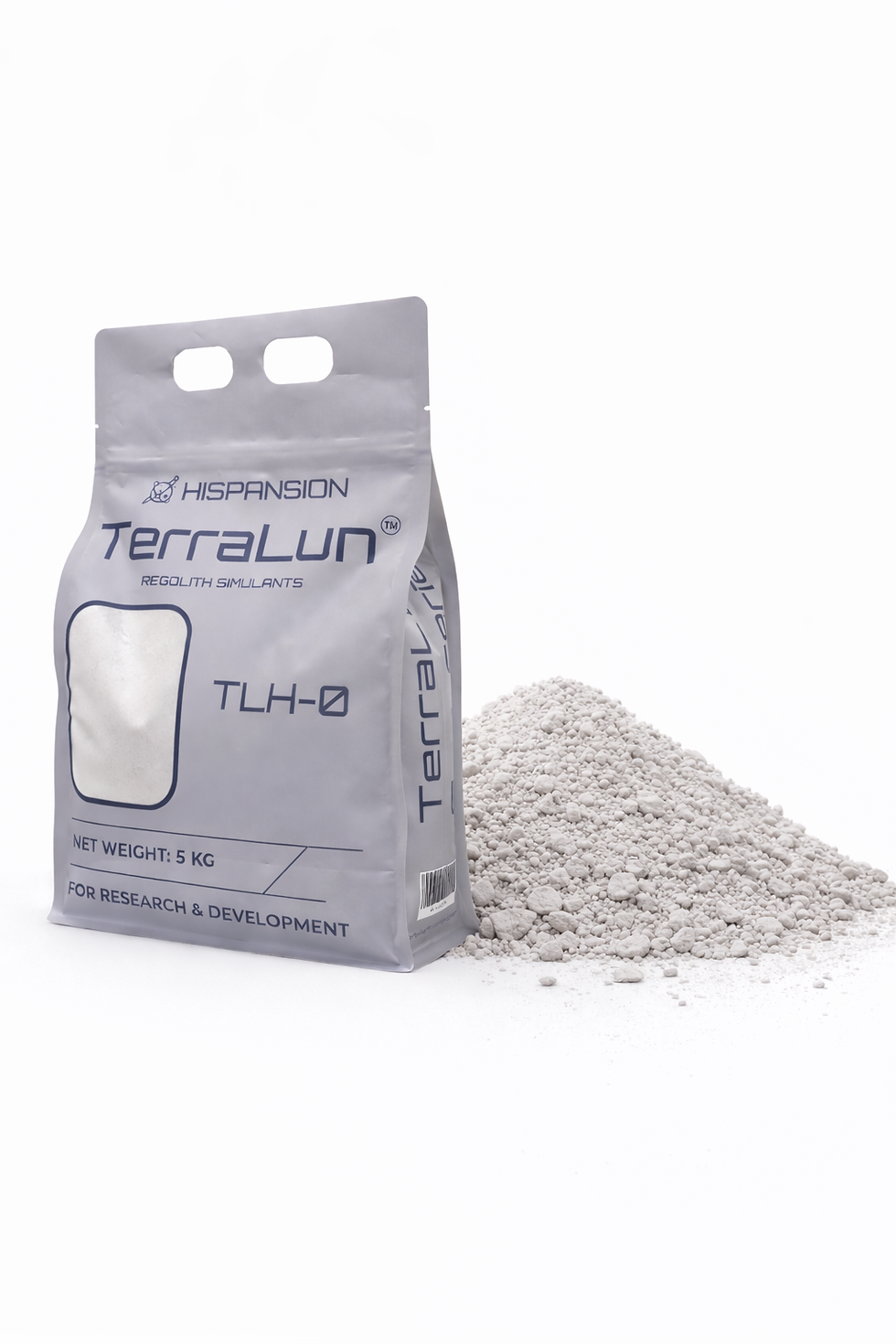
But not all simulants are equal. The quality of the data depends directly on the fidelity of the material. According to NASA’s Figures of Merit (FoM), Hispansion currently offers the highest-fidelity regolith simulant in the world.
This is not our own claim, independent third-party analyses support it, placing us as the best commercially available lunar regolith simulant.

Comments